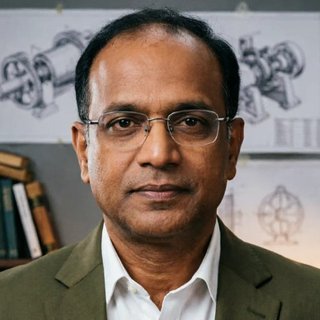

Three of Professor Ramesh Chandran's patents on compressed sensing algorithms for low-power medical monitoring are now licensed to medical device manufacturers building wearable cardiac monitors — a rare instance of signal processing theory reaching an actual patient's wrist. Twenty-four years at IIT Madras have built one of India's more productive academic research groups in signal processing and machine learning, recognised with the Shanti Swarup Bhatnagar Prize in 2018.
"The purpose of a research university is not to produce papers. It is to produce people who can produce papers — and then produce much more than that."
His more recent work on federated learning for distributed healthcare data — allowing hospitals to train shared models without centralising sensitive patient records — has attracted attention from health ministries as a possible architecture for national health data infrastructure, a considerably larger canvas than the compressed sensing work that first built his reputation.
He counts his thirty-four supervised doctoral students as his most durable contribution to Indian science. Several now hold faculty positions at IITs and international universities; three have founded startups; one leads AI research at a major Indian technology company. He was promoted to Full Professor in 2010, the youngest in his department at the time.
Senior Professor, EE Dept., IIT Madras; and Associate Editor, IEEE Transactions on Signal Processing.
Signal Processing & Compressed Sensing; Federated ML for Healthcare; and Biomedical Signal Analysis.
This is a demonstration profile and cannot be contacted.
An editorially composed record of your professional achievement that stays current.
Apply for an Editorial Profile →